










|


| |
|
|
| |
Prologue |
|
| |
|
 |
|
|
|
| |
|
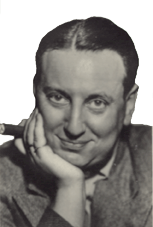
In the autumn of 1932, Max Ehrlich is at the
high point of his career: He is one of Germany’s most beloved comics,
masters of ceremony and cabaret stars.
His creative accomplishments include leading roles in
Max Reinhardt
productions, the Haller-Revuen, and other important cabaret as well as
stage groups. Also to his credit: forty-two movies, ten of which he
directed personally; eight records, including chansons, operetta, comedy
sketches and character imitations; not forgetting his best selling book
"From Adelbert to Zilzer," a touchingly humorous collection of stories
and anecdotes about sixty-two of his best known show business friends
and colleagues.
|
|
|
Then, in 1933, the National Socialists
bring this artistic élan to a grinding halt. Max Ehrlich - like his
other Jewish colleagues - may no longer work in Germany. He leaves for
Vienna to appear with the Nelson Revue. However, there too, Austrian
anti-Semites interrupt the show with cries of "Jews get out of Vienna".
So the troupe leaves for Holland, stopping en route to appear in
Switzerland.
x
|
| |
|
|
|
|
|
|
|
|
| |
Act 1:
Jewish Cultural Union |
|
|
Act 2:
Prisoner in Westerbork |
|
|
Act 3:
Theater of Despair |
|
| |
In 1935, homesick for his native land, Max Ehrlich returns to Nazi
Germany. Besides, Jewish entertainers once again may perform there, even
if only within the framework of the
Jüdische Kulturbund (Jewish Cultural Union) and exclusively in
front of Jewish audiences. Max Ehrlich is named director of the
Bund’s light theater department. But, following the 1938 pogrom, he
decides to leave Germany definitively. Both of his farewell performances
immediately sell out and a third presentation is added. Thus, on April
2nd 1939, before a full house of fans, crying out their affection and
encouragement, Max Ehrlich makes his final appearance in Germany. He
returns to Holland and joins Willy Rosen and his Theater der
Prominenten (Theater of Celebrities) where, even during the Nazi
occupation, Max Ehrlich remains.
|
|
|
Then in 1943 - like so many of his colleagues - Max Ehrlich is
imprisoned in Westerbork concentration camp. Here, he becomes director
of the "Camp Westerbork Theater Group," a cabaret troupe that, during
its eighteen month existence, stages six major theater productions
within the concentration camp’s confines. All the actors are prominent
artists from Berlin and Vienna, such as Willy Rosen, Erich Ziegler,
Camila Spira, and Kurt Geron; or well-known Dutch performers, like
Esther Philipse, Jetty Cantor and Jonny & Jones. At its high point, the
Group counts fifty-one members, including a full team of musicians,
dancers, choreographers, artists, tailors, make-up, lighting and other
technicians, as well as stage hands. Contemporary observers
unconditionally exclaim that the "best cabaret in Europe" now is in camp
Westerbork.
|
|
|
Most of the shows combine elements of revue and cabaret - songs and
sketches - but, on one occasion, the program includes a revue-operetta,
"Ludmilla, or Corpses Everywhere". A production whose theme sadly is a
presentiment of the actors’ and other prisoners’ fate. While some scenes
are implicitly critical, of course, the Theater Group - at no time -
produces openly political cabaret or directly attacks the Nazi regime.
To do so would violate the most fundamental condition for the troupe’s
continued existence. Besides, life in Westerbork is dominated by the
persistent threat of deportation on the next transport to an
unknown but deeply feared fate in the East. So, standing, helpless and
unaided before the fascists’ executioners and their lackeys, the Theater
Group, of necessity, limits itself to entertaining its audiences and to
momentarily distracting them from the surrounding horrors. But in so
doing, it also gives their captive audiences renewed hope and the
courage to face an otherwise unbearable existence.
|
|
| |
Final Curtain:
Auschwitz 1944
|
|
During the summer of 1944, increasing
numbers of transports carry Westerbork’s prisoners to the extermination
camps in the East. Of 107’000 camp inmates, less than 5’000 ultimately
survive. In the last transport to leave Westerbork, on September 4th
1944, Max
Ehrlich is number 151 on the list of victims. Eyewitnesses recount that, after
reaching Auschwitz extermination camp, he still suffers the misfortune
to be recognized by a Hauptsturmführer. As a result, Max Ehrlich
is subjected to an additional martyrdom: brought before a group of SS
brutes holding their loaded guns aimed at him, he is ordered to tell
jokes. Shortly thereafter, in late 1944, his Nazi captors murder him in
the Auschwitz gas chambers. At last, on April 12th 1945, British troops
liberate Westerbork. By then, only 876 prisoners are left: 464 men, 309
women and 229 children, of which only two Theater Group members.
|
|
|